
The Hidden Foundation – Why Your Feet May Be Causing Your Pain
Daryl C. Rich, D.C., C.S.C.S.
[Core] Chiropractic and Wellness
Your body is like a chain of connected parts—everything works together from your feet all the way up to your head. We call this the kinetic chain. Think of it as a line of dominoes: if the bottom one tips the wrong way, it knocks everything above it out of line.
Your feet are the foundation of this chain. They’re the first thing that touches the ground with every step, absorbing shock and helping you stay balanced. When your feet don’t work quite right, it creates a ripple effect that travels upward through your ankles, knees, hips, pelvis, and spine. This can lead to extra stress, uneven pressure, and pain—even if the pain shows up in your back or knees instead of your feet.
Here are some common foot problems we see that can throw things off:
- Flat feet or collapsed arches — Your arches drop too much, so your feet roll inward more than they should (called overpronation).
- High arches — These don’t cushion shock well, so forces shoot straight up your legs.
- Overpronation (feet rolling inward too much) or supination (rolling outward too much) — This changes how your legs and hips move.
- Small differences in leg length — Even a tiny imbalance can tilt your pelvis and curve your spine unevenly.
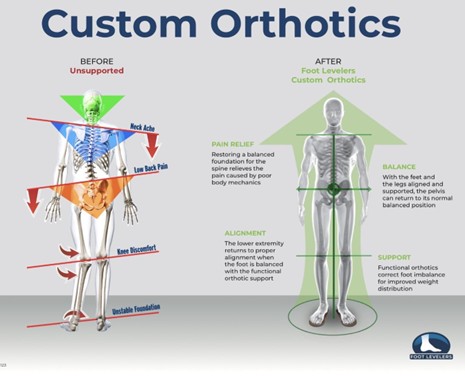
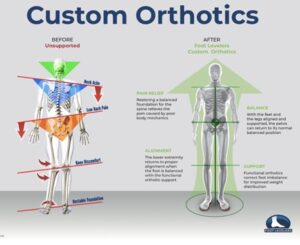
Imagine walking with your feet rolling inward: your knees might turn in, your hips tilt forward or to one side, and your lower back has to work harder to keep you upright. Over time, this extra strain builds up and can cause achy knees, tight hips, or nagging low back pain.
The good news? We can often help fix this starting at the source—your feet!
Custom orthotics (specially made supports that fit right into your shoes) gently guide your feet into a better, more natural position. They support your arches, control rolling, improve shock absorption, and help your whole body line up better. When your foundation is stable, your knees, hips, and spine don’t have to compensate as much. This means less uneven stress, fewer aches, and often real relief from pain—without needing surgery or relying on pain meds long-term.
Many of our patients notice improvements in their posture, walking, and overall comfort when we combine chiropractic adjustments (to keep your spine and joints aligned) with proper foot support. If you’ve been dealing with back pain, knee issues, or just feel “off” when you walk or stand, let’s check your feet and how they affect the rest of your body. A simple gait check or foot scan in the office can show us if this chain reaction is part of what’s going on for you. Your feet matter more than you might think. They are the key to feeling better from the ground up! If this sounds familiar, mention it at your next visit so we can take a closer look.
How Custom Orthotics Relieve Specific Pains
Custom orthotics are not just a cushion—they realign, redistribute weight, and restore proper biomechanics. Here’s exactly how they help each area:
Foot Pain
Plantar fasciitis, heel spurs, bunions, and general achiness often stem from unsupported arches and poor shock absorption. Orthotics cradle all three arches, reduce excessive stretch on the plantar fascia, and evenly distribute pressure. Many patients feel relief within days.
Knee Pain
Unstable feet cause the knees to collapse inward (valgus stress) or rotate abnormally. Orthotics stabilize the foundation, reduce uneven forces on the kneecap and ligaments, and often eliminate runner’s knee or chronic ache. Runners and athletes frequently report being able to return to training pain-free.
Hip Pain
When feet pronate, the thigh bone rotates inward, stressing the hip joint and destabilizing the pelvis. Proper orthotic support keeps the hip in neutral alignment, improves gait stability, and dramatically reduces hip and groin pain—especially for those who stand or walk on hard surfaces all day.
Back Pain
The feet are the base of your posture. Misaligned feet tilt the pelvis, which curves the lower spine and strains muscles and discs. Orthotics restore neutral pelvic position and spinal alignment, taking pressure off the lumbar region. A landmark 2017 randomized controlled trial published in the Archives of Physical Medicine and Rehabilitation found that custom orthotics alone reduced chronic low back pain by 34.5% and improved function by 18.5% in just six weeks. When combined with chiropractic care, pain dropped by 40.4%.
Bottom line: Treating the feet often resolves pain higher up—because the body works as one interconnected unit.
The 3-Arch Advantage
Only the best custom orthotics support the medial longitudinal, lateral longitudinal, and anterior transverse (metatarsal) arches—the “plantar vault.” This creates a stable, shock-absorbing foundation that generic inserts simply cannot match. Foot Levelers orthotics are the only ones designed to support all three functional arches of the foot. Over-the-counter inserts support just one arch (usually the medial) and can actually worsen imbalances. Foot Levelers create true plantar vault support that balances the entire body.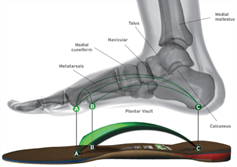
Made from a weight-bearing, digital laser scan, they enhance how your feet actually function. Each pair is hand-crafted with premium materials for maximum comfort and durability. Models exist for dress shoes, work boots, running shoes, sandals, and even custom flip-flops. Foot Levelers treat the body as a functional unit. Their orthotics are trusted by chiropractors, podiatrists, and physical therapists nationwide because they deliver measurable improvements in alignment, gait, and pain levels.
When to Replace Your Orthotics
Even the best orthotics wear out. Here are the clear signs it’s time for a new pair:
5 Signs Your Orthotics Need Replacing
- Pain returns — Foot, knee, hip, or back discomfort that had disappeared
starts coming back.
- Visible wear — Thinning, cracking, flattening, or pieces breaking off.
- Uneven shoe wear — One side of your shoes is wearing faster than the other.
- New calluses or corns — Friction points reappear because support is lost.
- They just feel “off” — Less supportive, uncomfortable, or no longer stabilize
your feet.
Typical lifespan
- Everyday use: 2-3 years
- High-activity (high mileage running, long hours of standing, heavy labor,
excessive body weight): 12-18 months
- Weight changes, pregnancy, or surgery can shorten this timeline.
Ready for Relief?
The first step is simple. We can perform a quick digital scan in just minutes. Then we will discuss what style of orthotic(s) fit your varied needs and make sure that you are well supported in your many activities. Your custom built orthotics will be ordered and ready for you in the office in about a week. We will give you instructions on how to break in your orthotics. Most patients feel comfortable in them and notice relief within a few days to a few weeks of use. If you have a problem, we can adjust the orthotics or replace them, if needed, with Foot Levelers 100%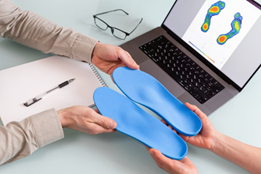 satisfaction guarantee.
Our goal at [Core] is to help you live your optimally healthy life. We understand that to accomplish this goal we need a properly working nervous system (chiropractic and acupuncture), healthy strong muscles (Active Release Technique and rehabilitative exercise), good nutrition (our [LivFit] class), and outside support when needed (orthotics and supplements). With this multidisciplinary approach, we are confident that we can achieve this goal with you and see you healthier than you have ever been.