

The Complete Runner’s Warmup
Daryl C. Rich, D.C., C.S.C.S.
[Core] Chiropractic and Wellness
CoreRoanoke.com
Runners log miles week after week, yet many still skip or rush the most protective part of training: a proper warm-up. In our office we are consistently encouraging our running athletes, and anyone who might be prone to a hip or leg injury with activity, that a short, purposeful dynamic warm-up sequence prepares the body far better than static stretching or jumping straight into exercise.
A proper warmup raises tissue temperature, improves joint mobility, activates key stabilizers, and primes the nervous system—dramatically lowering the risk of the overuse injuries that sideline so many athletes.
Why a Dynamic Warm-Up Sequence Matters for Injury Prevention
A lack of coordinated control through the hips, core, and lower extremity is one of the strongest predictors of a running injury. When the body cannot generate proper intra-abdominal pressure or maintain joint centration, compensatory patterns appear and tissues overload. Most of us were taught to do some static stretching before activity, but this has been shown to temporarily reduce muscle force production and power. This can lead to poor joint stability and injury, or to decreased speed and performance.
In contrast, dynamic warm-ups use continuous, controlled movement through a functional range of motion. A well-designed dynamic warm-up directly targets these issues before the first stride. Research and clinical experience consistently show that dynamic warmup sequences:
- Elevate muscle and core temperature, increasing tissue elasticity and blood flow.
- Improve joint lubrication and range of motion without creating temporary weakness.
- Activate the deep stabilizers and coordinate the nervous system so the body moves efficiently.
- Rehearse the exact movement patterns of running so the nervous system is ready.
- Reduce the incidence of common running injuries such as IT-band syndrome, runner’s knee (patellofemoral pain), shin splints, and hamstring strains.
The Complete Dynamic Warm-Up Sequence for Runners
Aim to complete the sequence below in 7–12 minutes. Start slowly and increase range and speed only as the body warms. Perform the exercises in the order listed so mobility work precedes activation and then higher-intensity drills.
- Easy March or Light Jog in Place (60–90 seconds)
Stand tall with soft knees. Begin marching in place, gradually lifting the knees higher and pumping the arms naturally. Progress to a very light jog if comfortable. This raises heart rate and core temperature without sudden loading. Focus on landing lightly under the body.
- High Knees (20–30 seconds or 20–30 total steps)
Drive one knee toward the chest while the opposite arm swings forward, just as in running form.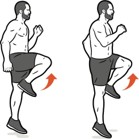 Keep the torso upright and the standing leg slightly bent. Land softly on the ball of the foot and immediately switch legs. This warms the hip flexors and quads while reinforcing proper knee drive.
- Butt Kicks (20–30 seconds)
Jog in place or move slowly forward while quickly kicking the heels toward the glutes. Keep the knees pointed downward and the torso tall. Emphasize quick, light ground contact rather than forcing the heel all the way up. This activates the hamstrings and prepares them for the swing phase of running.
- Front-to-Back Leg Swings (10–12 swings each leg)
Stand beside a wall or stable object and hold lightly for balance. Swing one leg forward and backward in a controlled pendulum motion, keeping the knee mostly straight and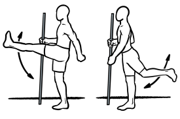 the pelvis level. Start with a smaller arc and gradually increase the range as the hip loosens. Avoid leaning or twisting the torso. Switch legs. This mobilizes the hip flexors and hamstrings through a running-specific plane.
- Lateral (Side-to-Side) Leg Swings (10–12 swings each leg)
Face the wall and hold on. Swing one leg across the body and then out to the side in a controlled arc. Keep the pelvis square and the swinging leg relatively straight. This opens the adductors and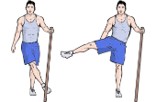 abductors—critical for side-to-side control that prevents knee collapse during single-leg stance.
- Walking Lunges (8–10 steps each leg)
Step forward into a lunge so the front knee is roughly over the ankle and both knees bend to about 90 degrees. The back knee drops toward the ground without touching. Push through the front heel to stand and step the back leg forward into the next lunge. Keep the torso upright and the core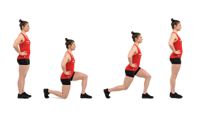 gently braced. For added benefit, reach both arms overhead or rotate the torso toward the front leg on each step. This strengthens the glutes and quads while dynamically stretching the hip flexors of the trailing leg.
- Toy Soldier / Straight-Leg March (8–10 steps each leg)
Walk forward while kicking one straight leg upward, trying to touch the opposite hand to the foot or shin. Keep the standing leg straight and the core engaged so the pelvis does not tilt. Move with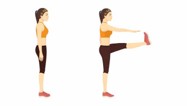 control rather than momentum. Excellent for hamstring length and hip mobility under dynamic conditions.
- World’s Greatest Stretch / Lunge with Twist (6–8 per side)
Step into a deep lunge. Place the hand on the same side as the front leg on the ground inside the foot. Rotate the torso and reach the opposite arm toward the ceiling, following the hand with the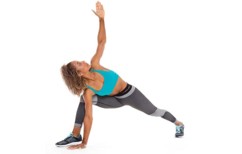 eyes. Hold the end range for 1–2 seconds, then switch sides while continuing forward. This single movement addresses hip mobility, thoracic rotation, and core control simultaneously.
- A-Skips or High-Knee Skips (20–30 meters or 15–20 contacts)
Skip forward with an exaggerated high knee drive, quick ground contact, and strong opposite-arm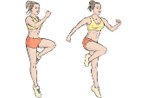 swing. Emphasize light, springy landings. This drill reinforces running mechanics and further activates the calves, glutes, and hip flexors at a higher intensity.
After completing the sequence, you should feel warm, loose, and coordinated—ready to begin your run at an easy pace for the first few minutes before settling into training effort.
How Active Release Technique Helps Running Injuries
Even the best warm-up and neuromuscular training cannot completely eliminate the cumulative stress of high-mileage running. Over time, small amounts of microtrauma lead to adhesions and scar tissue within muscles, fascia, tendons, and around nerves. These restrictions reduce elasticity, alter movement patterns, and create the classic overuse injuries of running. Active Release Technique (ART) is a patented, hands-on soft-tissue system that precisely locates and treats these adhesions. This helps to restore normal muscle function and sliding between structures, improves circulation, and allows the muscle to return to its proper length and strength again. ART is particularly effective for runners because it addresses the exact tissues stressed by repetitive impact and can produce measurable improvements in range of motion and pain in a relatively short series of treatments.
We have used ART extensively with endurance athletes for years. Combined with chiropractic adjustments when joint restrictions are present, acupuncture or dry needling for stubborn trigger points, and targeted rehabilitative exercises, our unique approach has helped runners recover fully and return stronger than before. Whether you are currently dealing with an injury that has limited your training or you simply want to train harder with fewer interruptions, a thorough evaluation can identify the specific soft-tissue restrictions and neuromuscular control deficits holding you back.